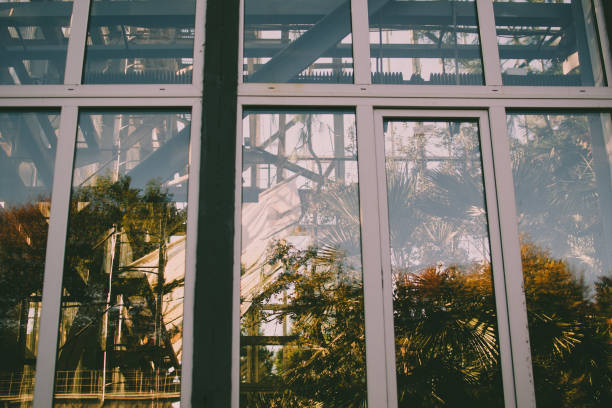
Conservatories were originally botanical hothouses, engineered to maintain highly localised microclimates. Their heat-retaining properties allowed homeowners to cultivate exotic flora imported from the tropics. Today, modern architecture has completely re-engineered this concept. Conservatories now also serve as residential extensions where the indoor living area merges with the exterior landscape.
Conservatories are appealing because they open up views of the outdoors and make a room feel larger. However, climate change and intense heatwaves in the UK render these structures uncomfortably hot and difficult to use in the summer.
If you are looking for solutions to make your sunroom more comfortable, options like window tints can help manage excessive heat and improve usability.
Addressing Extreme Heat in ConservatoriesWith Window Tints
In autumn, conservatories offer the best ambient experience because the crisp air outside creates a sharp contrast with the natural warmth captured within the glass walls. However, during summer, these glass rooms can reach interior temperatures as high as 50°C. When a heatwave hits, the space can become entirely unliveable.
You cannot solve this problem by simply bricking up the walls or installing heavy, opaque panels, as this would destroy the very essence of the conservatory. The ideal solution is to control the climate while preserving natural light.
One technology that has the specific properties to do this is window film. Instead of completely cutting off sunlight, advanced window film serves as a spectrally selective filter. Window tinting Bristol introduces a microscopic layer of multi-layered material coating to the glass that changes how solar energy enters and affects the interior space.
What Window Tints Should You Use for Conservatories?
A dual-reflective ceramic home window tint, specifically a 35% to 50% visible light transmission (VLT) variant, is the most effective option for your living spaces as they balance maximum performance with residential aesthetics. The film uses microscopic ceramic elements embedded within an optical resin layer to block high-energy solar rays. Its nano-ceramic particles are specifically tuned to absorb and reflect the sun’s invisible heat-generating wavelengths while allowing the wavelengths of visible daylight to pass through.
Ideally, you should pick a ceramic film with a total solar energy rejection (TSER) of 60% to 72% for conservatories. These films can reflect up to three-quarters of the sun’s total combined heat, light, and UV. Conservatories with proper solar control measures have been known to drop internal room temperature by 8°C to 10°C. At the same time, ceramic window films do not have the inside mirror effect at night, so you always have an outside view.
Transform Your Conservatory with Global Tint UK
Do not let your conservatories become dead spaces in the summer. By installing home window tints, you can make your conservatory more comfortable throughout changing weather conditions. Find the right home window tint you need today at Global Tint UK.
As the UK’s largest window tinting network, Global Tint UK operates across more than 140 local branches to deliver high-performance architectural glazing retrofits. We do not just provide generic window treatment options. Instead, we offer highly durable window films designed for long-term climate control and structural protection.
Get an instant quote for high-performance residential film options in the UK today.